How One Daily Question Changed My Habits
For years, I struggled with habit tracking. I downloaded every app, filled out complex forms, set reminders, and created elaborate systems. Yet nothing stuck. The apps felt overwhelming, the process felt like work, and I'd abandon them within weeks.
Then I discovered something profound: one simple question changed everything.
The Problem with Complex Habit Trackers
Most habit tracking apps are feature-rich monsters. They want you to:
- Log multiple habits daily
- Set streaks and goals
- Track detailed metrics
- Share progress on social media
- Join communities and challenges
- Customise every aspect of the experience
This complexity is exactly what kills habit formation. When tracking becomes a chore, you'll stop doing it. When an app requires more cognitive load than the habit itself, you'll abandon it.
The research is clear: simplicity beats features when it comes to habit formation. James Clear, author of "Atomic Habits," emphasises that the best habit tracking system is the one you'll actually use.
The Power of One Question
What if instead of logging everything, you asked yourself just one question each day?
"Did I do it today?"
That's it. No forms to fill, no metrics to track, no streaks to maintain. Just a simple yes or no.
This minimalist approach has a surprising psychological effect:
- Reduces friction - Decision fatigue is real. One question is effortless.
- Maintains focus - You concentrate on one habit, not twenty.
- Creates clarity - Simple questions yield clear answers.
- Builds consistency - Easy systems get used consistently.
My Experience with DailyPing
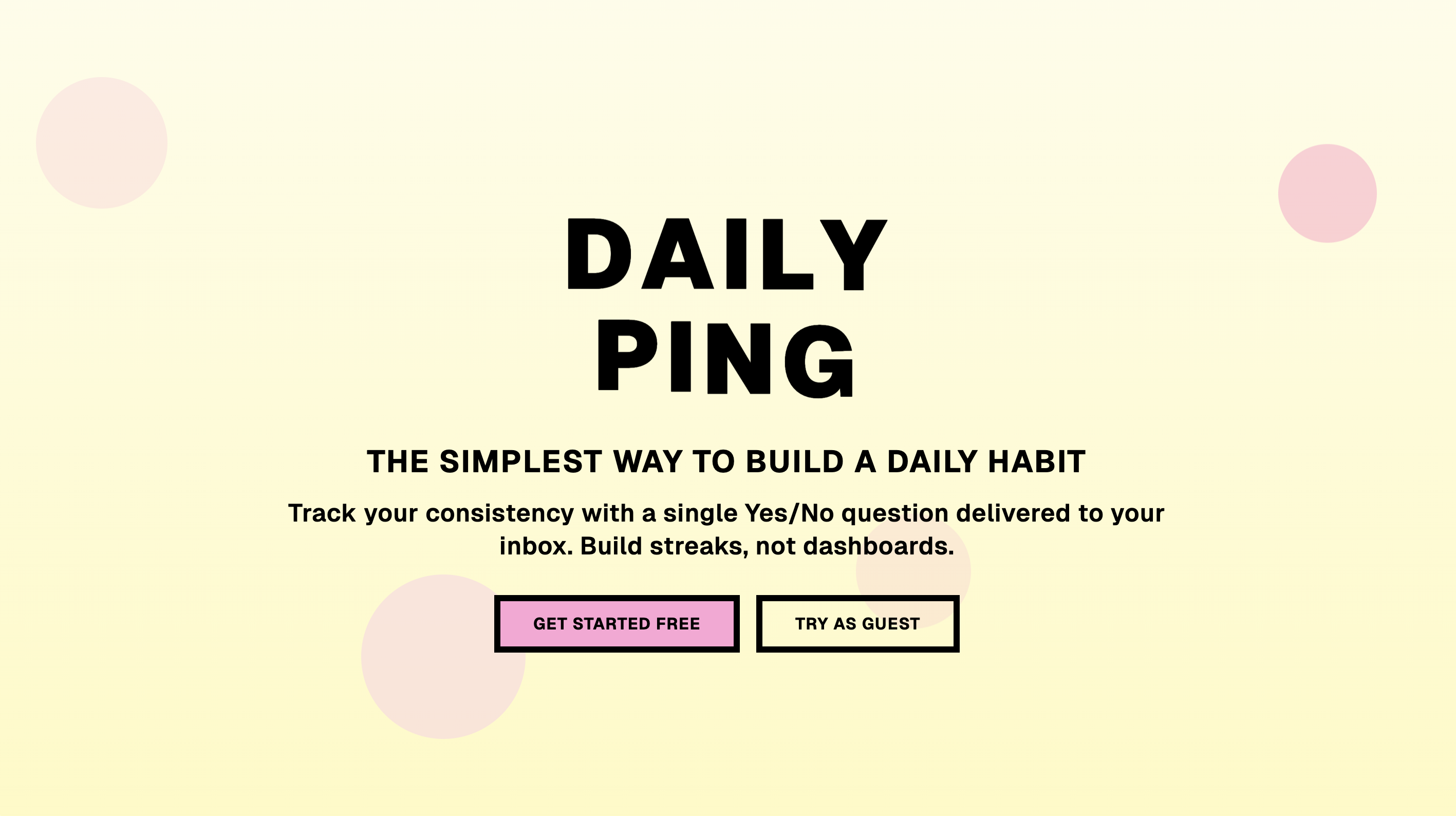
When I started building DailyPing (a simple habit tracker built around this philosophy), I finally understood what habit tracking should feel like: effortless.
The app does one thing well: it asks you a daily question. That's the entire interaction. There's no complex onboarding, no feature discovery, no learning curve. You open the app, answer the question, and you're done.
The result? I've maintained my daily habit for longer than I've ever stuck with any tracking method.
The Science Behind Simplicity
Behavioural science supports this approach:
- Cognitive load theory shows that simple tasks are more likely to be completed
- The Zeigarnik effect suggests that incomplete simple tasks create stronger mental reminders
- Implementation intentions work best when they're clear and unambiguous
A single daily question leverages all these principles without overwhelming your mental resources.
Why Simple Habit Trackers Win
Complex apps create several problems:
- Choice paralysis - Too many options make decisions harder
- Guilt cycles - Missing one habit feels like failing the entire system
- Feature fatigue - You spend more time learning the app than building habits
- Privacy concerns - Complex apps collect more data than necessary
Simple habit trackers like DailyPing solve these by:
- Offering one clear action (answer the question)
- Focusing on the present moment (today, not yesterday's missed streak)
- Requiring zero learning (you already know how to answer yes/no)
- Minimising data collection (privacy by design)
Building Lasting Habits the Minimalist Way
Here's what I learned about building habits that stick:
1. Start with One Habit
Don't try to build multiple habits simultaneously. Focus on one until it becomes automatic. Usually 66 days according to research.
2. Make It Binary
Avoid "how much" or "how well." Stick to "did I do it?" This eliminates excuses and simplifies decision-making.
3. Remove All Friction
If tracking takes more than 5 seconds, it's too complex. The best habit tracker is invisible, you barely notice using it.
4. Focus on Consistency, Not Perfection
Missing a day isn't failure. The goal is consistency over time, not perfect streaks.
5. Trust the Process
Simple systems work because they remove decision-making. You don't need motivation when you have automation.
The Minimalist Productivity Movement
There's a growing movement toward minimalist productivity tools. Apps like DailyPing, Streaks, and Done represent a shift away from feature-heavy applications toward focused, purpose-built tools.
This isn't just a design trend, it's based on understanding human psychology. We're not machines that need complex dashboards. We're humans who need clear, simple prompts.
Your Turn: Start with One Question
If you've struggled with habit tracking, I challenge you to try this approach:
- Pick one habit you want to build
- Frame it as a simple yes/no question
- Answer it daily for 30 days
- Notice how effortless it feels compared to complex systems
You might find, like I did, that less truly is more when it comes to building lasting habits.
Conclusion
One daily question changed my entire approach to habit formation. By embracing simplicity over complexity, I've built a habit that's lasted longer than anything I tried with feature-rich apps.
If you're looking for a simple habit tracker that focuses on privacy and minimalism, check out DailyPing. It's built for people who want to track habits, not manage apps.
Remember: The best habit tracking system is the one you'll actually use. And that's almost always the simplest one.
Ready to start your habit journey? Try a privacy-focused streak app that respects your data and your time. Focus on what matters: building the habit, not learning the tool.
Oh, and one more thing. Since you're reading this, you can use code "CodeWizard" for 100% off (first 100 claims).